
Why TruLight's 48-Volt System Outperforms Every Other Permanent Lighting Brand in Chicago
July 20, 2026 · 5 min read
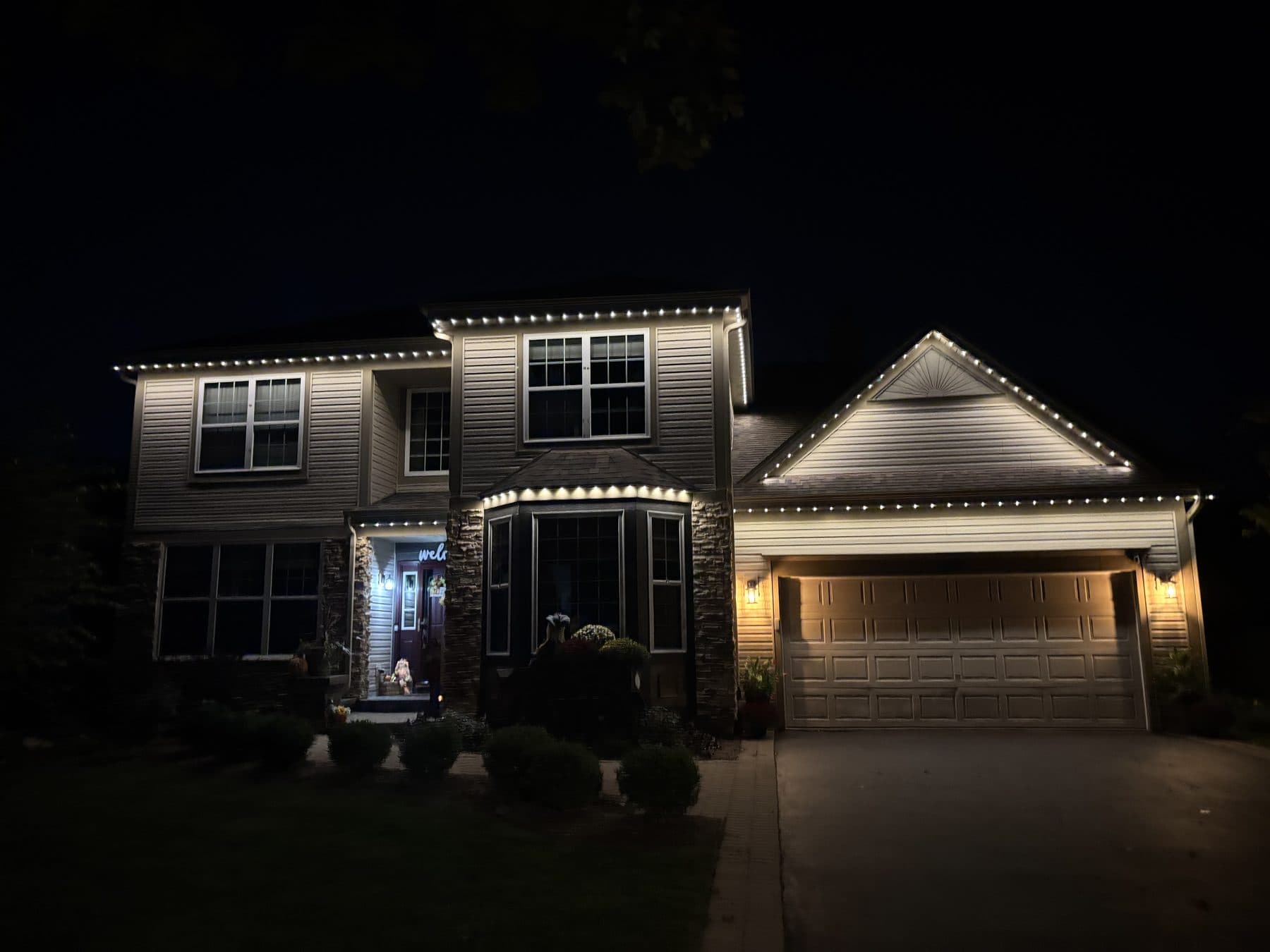
Drive through Wheaton or Elgin on a winter evening and look at the rooflines. Wide brick colonials. Craftsman two-stories with long, continuous eaves. Farmhouse builds that run 150 feet or more without a break. These are exactly the homes where the difference between a 12-volt and a 48-volt permanent lighting system stops being a spec sheet detail and starts being visible from the street.
Most permanent lighting ads lead with colors and apps. Those matter, but voltage is the spec that actually determines your installation cost, how clean the finished look is, and how the system holds up ten winters from now. A lot of brands on the market are running hardware that wasn't built for a home with a roofline this long.
What Voltage Actually Controls
Voltage determines how far a lighting system can run from a single power supply before it needs another injection point to keep the far end of the run at full brightness. TruLight's 48-volt system covers up to 300 feet from one power supply. A 12-volt system — Trimlight is the most common example — needs a new power box roughly every 50 feet.
Every extra power supply means another box mounted to your fascia, another wiring run, and another set of penetrations through your soffit exposed to Chicago's freeze-thaw cycles every winter. A 200-foot roofline, which isn't unusual on the larger colonials and farmhouses across Naperville, Wheaton, or Elgin, needs four separate power boxes on a 12-volt system. TruLight covers the same roofline with one.
How TruLight Compares to Other Permanent Lighting Brands
Voltage alone doesn't tell the whole story — what's inside each light node matters just as much. Here's how TruLight stacks up against the two other brands homeowners ask us about most:
JellyFish also runs on 48 volts, but voltage isn't the whole picture. TruLight's node uses 6 LEDs — 3 RGB and 3 dedicated warm white — while JellyFish uses 3 RGB LEDs and approximates white in software, and Trimlight has no dedicated white channel at all. That shows up directly in brightness: TruLight's 90 to 120 lumens per node is visible from across the street, while the 27–30 lumen range of the other two produces a softer effect that reads less clearly on a long roofline.
| Feature | TruLight | Trimlight | JellyFish |
|---|---|---|---|
| Voltage | 48V | 12V | 48V |
| LEDs per Node | 6 (3 RGB + 3 warm white) | 1 (3 diodes, RGB only) | 3 (RGB only) |
| White Light | True RGBW (pure white) | No white channel | Approximated via algorithm |
| Lumens per Node | 90–120 | Up to 30 | Up to 27 |
| Power Supply Distance | Every 300 ft | Every 50 ft | Every 300 ft |
| Wiring | 4-wire (redundant data) | 3-wire | 4-wire (redundant data) |
| Warranty | Lifetime, transferable | Lifetime (50K hr LEDs) | 5 years, non-transferable |
| LED Lifespan | 100,000+ hours | 50,000 hours | 50,000 hrs (22K hr controller) |
Why Chicagoland's Wide Rooflines Need 48 Volts
Chicagoland has no shortage of long, continuous rooflines — sprawling colonials in Wheaton and Bartlett, wide farmhouse builds in Elgin and Sugar Grove, craftsman two-stories throughout Naperville and Woodridge. A single-story or story-and-a-half home in these neighborhoods can easily run 150–200 feet of unbroken fascia.
That length is exactly where a 12-volt system starts to show its seams — literally. A 200-foot roofline needs four power boxes on 12 volts: four wiring runs, four sets of penetrations through the fascia, each one a spot for winter moisture to work its way in over time. TruLight covers that same 200 feet with a single power supply — one box, one connection, one clean install that isn't broken up by hardware.
Why Power Injection Points Add Cost
A power injection point is simply a spot along the roofline where additional power is fed into the system to keep it running at full brightness. On a 12-volt system, that's roughly every 50 feet. On TruLight's 48-volt system, it's every 300 feet — and that gap has a direct effect on both installation cost and long-term durability.
Every injection point is more hardware, more wiring, and more holes cut into your fascia and soffit. In Chicago, those penetrations sit through months of freeze-thaw cycles, ice damming, and heavy snow load — each one is a potential point of water intrusion if it isn't sealed perfectly and stays that way. Fewer penetrations means fewer places for that to go wrong, and it also means less labor on install day: more injection points mean more wire runs, more mounted hardware, and more connections to test before the crew leaves.
True RGBW at 48 Volts: The LED Design Behind the Difference
The voltage is the foundation, but the node design is what separates TruLight from the rest of the Chicago market. Each TruLight node carries 6 LEDs — 3 RGB and 3 dedicated warm white. That's true RGBW: when you set the system to warm white, dedicated warm-white LEDs fire, not a software blend of red, green, and blue trying to approximate it.
That distinction matters most on brick and stone — which describes a lot of Chicagoland's colonials, craftsman homes, and stone-front estates. Real warm white brings out the texture and tone of brick or stone in a way an algorithm-approximated white doesn't quite replicate. Beyond the static warm-white look, true RGBW opens up millions of color options — dial in a specific amber for everyday ambiance, or switch straight to team colors on game day — along with animated patterns and music sync for more than a single static scene.
Security Lighting for Chicago's Long Winter Evenings
A brighter system does more than look better — it works harder for security, and that matters more during Chicago's long stretch of early winter darkness. TruLight integrates motion sensors that trigger a full-brightness scene the moment movement is detected around your property. At 90 to 120 lumens per node, that's enough light to genuinely illuminate a yard or driveway, not just suggest one.
The 4-wire design adds another layer of reliability that matters over a full Chicago winter: TruLight runs a redundant data cable, so if one node fails, every other light on the run stays on. On the 3-wire systems most other brands use, a single failed node can take out everything downstream of it until it's replaced — a bigger deal on a system that's expected to run every night, year-round.
Frequently Asked Questions
Is 48-volt permanent lighting safe for residential homes?
Yes. TruLight's 48-volt system is low voltage — well below the 120 volts running through your home's standard outlets. It plugs into a regular outlet through a power supply that converts household electricity down to 48 volts, and the track itself mounts below your fascia and soffit, rated for outdoor use through Chicago's full range of weather. We confirm any local electrical requirements before installation.
How long do 48-volt permanent LED lights last?
TruLight's LEDs are rated for over 100,000 hours — roughly 34 years at 8 hours of use per night. That compares to about 50,000 hours (roughly 17 years) for Trimlight, and 50,000 hours for JellyFish's LEDs with a controller lifespan of only 22,000 hours. Every TruLight install includes a lifetime, transferable warranty that passes to the next owner if you sell your home.
Who has the best permanent outdoor lighting in Chicago?
Based on published manufacturer specifications, TruLight is the only system in the Chicagoland market combining 48-volt architecture, true RGBW (6 LEDs per node), 4-wire redundancy, and a lifetime transferable warranty in one package — 90 to 120 lumens of brightness, 300 feet of coverage per power supply, and 100,000+ hours of LED lifespan.
Can I control TruLight from my phone?
Yes. TruLight connects to an app that lets you set colors, build schedules, save custom scenes, and trigger security modes from anywhere. Warm white for everyday curb appeal, team colors for game day, red and green for the holidays — zoning lets different sections of your home run different colors at once, and music sync turns your roofline into a show for a backyard gathering.
The 48-volt difference is most obvious on install day — one clean power supply instead of four boxes mounted across your fascia. On a long roofline, that also tends to mean less labor and less hardware. And it's the kind of thing the whole block notices the first night you switch on true white and your brick or stone glows from the street.
Call us at 630-552-6331 or request your free quote, and we'll show you what 48 volts looks like on your home.